Flat, Eggshell, Satin or Semi-Gloss: Paint Sheen by Room
Sheen decides how well a wall hides dents and how hard you can scrub it. Compare flat, matte, eggshell, satin, semi-gloss and gloss side by side, then match each to the right room and surface.
Drafted with AI. This version has not been reviewed by an editor, so it carries no ads — how we work.
Pick the sheen by how the room gets used, not by how the paint looks in the can: flat for ceilings and walls nobody touches, eggshell for living rooms and bedrooms, satin for hallways, kids' rooms and kitchens, and semi-gloss for trim, doors and steamy bathrooms. The trade-off is fixed. The shinier the finish, the more it stands up to scrubbing and the more every dent, patch and roller mark shows. This guide is for the moment you have a color chosen and a counter full of finish names in front of you, and it compares each sheen side by side so you can decide surface by surface.
It covers interior walls, ceilings and trim. Exterior siding, floors and cabinets need specialty coatings with their own finish rules, so treat those as separate projects.
What sheen changes on a wall
Sheen is how much light the dried paint reflects. A flat finish has a rough surface at a microscopic level, so light scatters in every direction and the wall reads as soft and even. As the sheen rises, the surface dries smoother and harder, and more light bounces straight back like a dull mirror.
That one property drives three things you will notice for years:
- Flaw visibility. Scattered light blurs small bumps, patched nail holes and drywall seams. Reflected light outlines them.
- Washability. A smoother, harder film gives dirt less to grip and survives a sponge. Flat paint holds marks in its texture and can wear through or go shiny when rubbed.
- Touch-up ease. Flat paint blends into old paint almost invisibly. Glossier finishes often show a patch as a slightly different shine, even when the color is identical.
The sheens side by side
| Sheen | Hides flaws | Scrubbability | Touch-up ease | Typical rooms and surfaces |
|---|---|---|---|---|
| Flat | Best | Poor; wipe gently only | Easiest, usually invisible | Ceilings, adult bedrooms, formal dining rooms |
| Matte | Very good | Fair to good, depending on product | Easy | Living rooms, bedrooms, home offices |
| Eggshell | Good | Good; handles wiping | Fairly easy | Living rooms, bedrooms, family rooms |
| Satin | Fair | Very good | Harder; patches can flash | Hallways, kids' rooms, kitchens, laundry rooms |
| Semi-gloss | Poor | Excellent | Hard; usually repaint the whole piece | Trim, doors, bathrooms with showers |
| Gloss | Poorest | Excellent | Hardest | Front doors, railings, statement trim |
Read the table as a slider rather than six separate products. Moving one step down buys durability and costs you forgiveness. Within the same product line, the price difference between sheens is usually small, so cost rarely needs to drive the choice; the condition of your walls and how often people touch them should.
Why shiny walls show every dent
Raking light is the culprit. When sunlight from a window or a bright fixture skims along a wall at a low angle, every slight bump casts a tiny shadow and every hollow catches a highlight. On a flat wall those details dissolve because the surface scatters light anyway. On satin or semi-gloss, the reflection exposes them.
The same effect reveals roller texture. A roller leaves a faint orange-peel stipple, and if you rolled one section after the edge of the previous one had started to dry, you get lap marks: stripes where paint built up in two layers. On flat paint you may never see them. On a satin wall next to a big window, they can show as bands every afternoon. If you have a long wall facing a window, a lot of patched drywall or older plaster with waves in it, that is a strong argument for staying at matte or eggshell.
Why touch-ups flash on satin and semi-gloss
Flashing is when a touched-up spot shows as a shinier or duller patch even though the color matches. It happens because sheen depends on how the paint was applied and how thickly. A dab from a small brush lays down a different film thickness and texture than the original roller coat, and on a reflective finish that difference shows as a change in shine. Paint that has aged on the wall for a few years has also dulled slightly, so fresh paint beside it looks glossier.
Flat paint has almost no shine to mismatch, so a touch-up usually disappears once dry. With satin and semi-gloss, plan on repainting from corner to corner, or the whole door or length of trim, rather than spotting one scuff. If you use the same applicator type as the original coat and feather the edges outward, an eggshell patch often blends acceptably.
Flat and matte: ceilings and low-traffic walls
Flat is the standard for ceilings because you look at them from sharp angles under overhead lights, the exact conditions that expose seams and texture. Nobody scrubs a ceiling, so flat's weakness doesn't matter there.
On walls, flat suits rooms that see little contact: an adult bedroom, a formal dining room, a guest room. To clean it, dab with a damp sponge and a little mild soap rather than scrubbing. Rub hard and you can burnish the paint, polishing a shiny spot that looks worse than the original mark.
Matte versus flat
Matte sits just above flat in sheen. It keeps most of flat's flaw-hiding look but usually forms a tougher film. Many premium lines now sell a washable or scrubbable matte, which blurs the old rule that a non-shiny wall can't be cleaned. Because naming isn't standardized, one brand's matte may be another's flat, so read the label's cleaning claims rather than relying on the word.
Eggshell: the default for living rooms and bedrooms
Eggshell has a faint glow, roughly like the surface it's named for. It is the safe middle choice: it hides most minor imperfections, wipes clean after a spill or a scuff, and touches up reasonably well. That combination is why it suits living rooms, family rooms, bedrooms and home offices, where walls get occasional hands and furniture bumps but not daily scrubbing.
Choose eggshell over matte when you have pets that brush the walls or a sofa that rubs against one. Choose matte over eggshell when the walls are rough, heavily patched or lit by strong side light. In calm, pared-back rooms, a low-sheen wall also keeps attention on the shapes and materials, a principle that carries through most minimalist decorating.
Satin: hallways, kids' rooms and kitchens
Satin is the workhorse for walls that get touched, splashed and wiped often. Hallways collect handprints and bag scrapes at the same height all the way along. Kids' rooms collect crayon and food. Kitchens collect grease, which settles on walls near the stove and needs a degreasing wipe that would wear down flatter paint. Laundry rooms and mudrooms fit here too.
The cost is visibility. Satin shows roller marks and patched spots more than eggshell, so spend extra time on prep: fill and sand holes flush, prime the patches, and roll each wall in one continuous session, keeping a wet edge so you don't create lap marks. Give satin walls a careful look under the room's actual light before you call a coat finished.
Semi-gloss and gloss: trim, doors and bathrooms
Semi-gloss is the usual choice for baseboards, door and window casings, and interior doors. These surfaces take kicks, vacuum bumps and fingerprints around handles, and semi-gloss lets you scrub them without wearing the paint. The shine also gives trim a crisp edge against the walls. Because brush marks and drips show clearly, use a good-quality angled brush, apply thin coats and sand lightly between them.
Full gloss goes further: the hardest film and a lacquered, almost wet look. It suits a front door, a stair railing or trim you want to stand out, but it exaggerates every flaw, so it rewards meticulous sanding and punishes shortcuts. For most rooms, semi-gloss is the practical ceiling.
Bathrooms with showers
In a bathroom where steam builds daily, satin or semi-gloss walls resist moisture and repeated wiping far better than flat. Flat paint absorbs condensation more readily and is harder to clean when mildew spots appear. Semi-gloss gives the most protection in a small, poorly ventilated bathroom; satin is a softer-looking compromise where there is a working exhaust fan. Paints sold for bathrooms often include a mildew-resistant additive, which helps, but no finish replaces running the fan during and after showers. For the ceiling in a steamy bathroom, a ceiling paint labeled for high-humidity rooms or a satin finish holds up better than ordinary flat.
Matching sheen across walls, trim and ceiling in one room
The most common pairing is flat ceiling, eggshell walls and semi-gloss trim. Each surface gets a sheen suited to its job, and the step up in shine from wall to trim gives a clean, defined edge. Shift the whole set one step glossier for harder-working rooms.
| Room | Ceiling | Walls | Trim and doors |
|---|---|---|---|
| Living room or bedroom | Flat | Eggshell (or matte for rough walls) | Semi-gloss |
| Hallway or kids' room | Flat | Satin | Semi-gloss |
| Kitchen | Flat or satin | Satin | Semi-gloss |
| Bathroom with shower | High-humidity ceiling paint or satin | Satin or semi-gloss | Semi-gloss |
A few rules keep a room coherent. Keep every wall in one room the same sheen, since different sheens on adjoining walls look like a mistake in side light. Keep trim one consistent sheen throughout the house so hallways and rooms flow. If you paint walls and trim the same color, a contrast in sheen alone, such as eggshell walls and semi-gloss trim, still separates them subtly.
Switching from glossy to flat, or the reverse
Going from a lower sheen to a higher one over sound paint usually needs only cleaning and a light scuff. Going from semi-gloss or gloss to a flatter finish needs more care: new paint grips a slick surface poorly, so sand it dull or use a bonding primer first, or the new coat may peel or scratch off.
Comparing sheens before you buy
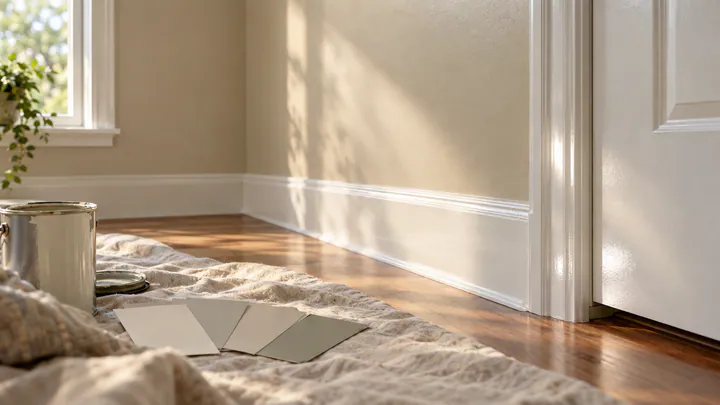
Sheen names are not standardized. Manufacturers measure gloss with an instrument at a fixed angle, but each sets its own range for each name, so one brand's eggshell can be shinier than another's satin. Compare the actual sample cards side by side in person, and tilt them toward a light to see how they reflect, rather than trusting the label.
Better still, buy a sample of your color in the sheen you're considering and paint a patch at least two feet square on the wall that gets the most raking light. Check it in the morning, in afternoon sun and under lamps at night. If the patch reveals bumps you can't live with, drop one sheen; if you already know the wall will take daily wiping, accept a little more shine and spend the time on prep instead.