The Astronomer Who Kept a Second Sky
High above a mill town, an aging sky-watcher paints a mirrored heaven on her observatory ceiling — and the child who visits her begins to notice it changing on its own.
Drafted with AI and published automatically. Our editors set the standards and fix reported errors — how we work.
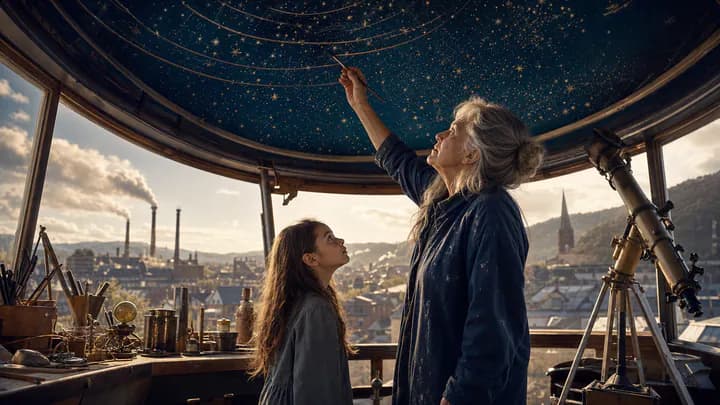
The observatory sat on the hill above the mill town like a white mushroom that had forgotten to close its cap. The dome had not turned in seven years, not since Miss Ivar retired, and everyone in Ashfell assumed the great brass telescope inside had gone to sleep with her.
Everyone except Nell, who was nine and had discovered, one Tuesday in October, that the side door was unlocked.
She had come up the hill to look for chestnuts. The wind smelled of wet iron from the mill and something warmer — coffee, maybe — leaking from the crack beneath the observatory door. Nell knocked. Nothing. She pushed. The door gave with a sound like an old book opening.
Inside, the round room was cold and blue and full of ladders.
"If you're here to steal something," said a voice from somewhere near the ceiling, "there's nothing but paint and biscuits, and the biscuits are stale."
Nell looked up. A woman in a canvas smock was strapped to a scaffold that ran around the inside of the dome, one long brush in her hand, her white hair pinned with what looked like a pencil. Above her, spread across the whole underside of the dome, was a sky.
Not a photograph. A painting. Dark blue deepening to black at the crown, and stars — hundreds of stars — some the size of pinheads, some fat as coins, each one placed with the careful ache of a person who had spent a life staring at the real thing.
"I'm Nell," said Nell.
"I'm busy," said the woman. Then, after a pause: "There are biscuits on the desk. Don't touch the sextant."
The Second Sky
Nell came back the next day, and the next. Miss Ivar did not invite her, exactly, but she left the door unlocked, which Nell decided was the grown-up version of the same thing.
The painting was called, Miss Ivar said, the Second Sky. She had been working on it for six years.
"Why paint a sky," Nell asked, "when there's already one outside?"
"Because the one outside is going away," Miss Ivar said. She dipped her brush. "The mill lights. The town lights. The lights from the new road. Every year I could see fewer stars from up here. So I began to keep the ones I remembered."
"Keep them where?"
"On the ceiling. Where they can't be washed out."
Nell tilted her head back until her neck hurt. She could pick out shapes she half-knew — a hunter, a bear, a long curling river of milky dots. But there were other shapes too, ones she'd never seen in any book. A rabbit made of six stars. A teacup. A small, tidy house with a star for a chimney.
"That's not a real constellation," Nell said, pointing at the house.
Miss Ivar squinted down at her. "It is now."
By the third week, Nell had learned the rules. Do not touch the sextant. Do not open the shutter — the crank was stiff and would pinch. Do not ask about the framed photograph on the desk, the one of a young man laughing beside a smaller, dark-haired Miss Ivar. Bring the biscuits from the tin, not the packet; the tin ones were older but better.
She had also begun to notice something odd.
The Second Sky was changing.
Not in the places Miss Ivar was painting. Those Nell watched grow slowly, star by star, under the tip of the brush. It was the finished parts that shifted. One morning the rabbit had seven stars instead of six. A week later the teacup had a saucer. And one Thursday, Nell was almost certain that the little house on the ceiling had gained a window — a single warm yellow dot in the wall — that had not been there on Wednesday.
She stood beneath it, mouth open.
"Miss Ivar," she said carefully. "Do you paint at night?"
"I sleep at night," said Miss Ivar, from her scaffold. "Sleep is the one thing I still do well."
"Then who added the window?"
Miss Ivar's brush stopped. For a long moment the observatory was silent except for the wind pressing against the dome. Then, slowly, she climbed down.
She stood beside Nell and looked up.
"Well," she said. Her voice had gone soft in a way Nell had not heard before. "Isn't that something."
What the Ceiling Remembered
They sat on the floor with the tin of biscuits between them.
"When I was your age," Miss Ivar said, "my brother and I had a game. We made up constellations. Not the official ones — our own. A rabbit, because he liked rabbits. A teacup, because our mother drank tea from morning to night. A house, because we wanted one that was only ours."
"The one with the window?"
"The one with the window." Miss Ivar took a biscuit and did not eat it. "He died when I was eleven. I became an astronomer partly, I think, because the sky was the last place I could still put him. Up there, where nothing gets lost."
Nell thought about this. "But things do get lost up there. You said. The lights."
"Yes."
"So you painted him a new sky."
Miss Ivar looked at her sideways, as if surprised to be understood so quickly. "I suppose I did."
"Then maybe," Nell said, "he's painting back."
The wind sighed against the dome. Miss Ivar did not answer for a while. When she did, her voice was very steady, the way voices get when they are carrying something heavy and do not want to drop it.
"That's a kind thing to say," she said. "I don't know that I believe it. But it's a kind thing to say."
Nell shrugged. "I'm nine. I'm allowed."
Nell kept visiting through the winter. The Second Sky kept changing — small things, always small. A bird appeared near the hunter's shoulder. The river of milky dots grew a bend. One February morning, the teacup steamed: three faint pale stars rising from its rim in a curl.
Miss Ivar stopped pretending to be surprised. She began, instead, to leave space. A patch of unpainted dome above the little house. A blank stretch by the rabbit's ear. "Room," she said, when Nell asked. "In case somebody needs it."
In March, Miss Ivar caught a cold that turned into something worse, and for two weeks the observatory door was locked. Nell left biscuits on the step. When Miss Ivar opened the door again she was thinner, and moved more slowly, and did not climb the scaffold anymore.
"You'll have to do the high parts," she told Nell, and handed her the brush.
Nell was terrified. She painted a single small star, badly, near the rabbit.
"There," said Miss Ivar. "You're an astronomer now."
Miss Ivar died in the spring, quietly, the way she had done most things. She left the observatory to the town with a note that said it was to remain open to any child who wished to visit, and that the side door was never to be locked.
Nell is grown now. She teaches at the school in Ashfell, and once a week she takes her students up the hill. They lie on their backs on the cold floor and look up at the Second Sky, and she tells them the names of the constellations — the hunter, the bear, the rabbit, the teacup, the little house with its one warm window.
Sometimes, when no one is watching, she checks the blank patches.
Sometimes there is a new star there.
She has stopped being surprised. She has started, instead, to leave more room.