The Bookmobile Driver of Route Seven
On the last stop of her final route, a bookmobile driver meets a passenger she never expected to find waiting at the end of a gravel road.
Drafted with AI and published automatically. Our editors set the standards and fix reported errors — how we work.
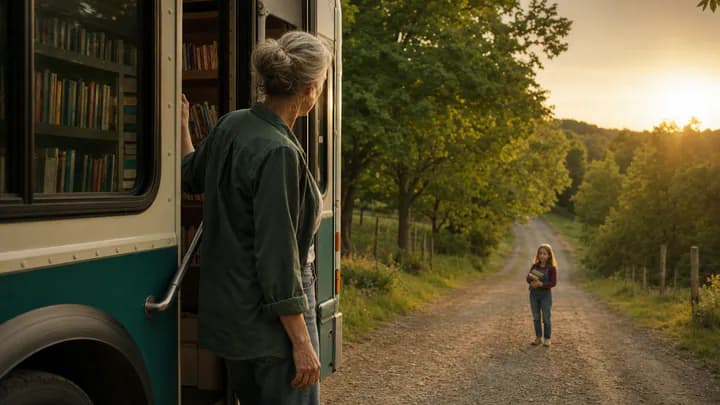
The engine coughed twice at the top of Fenner's Hill, the way it always did, and Delma answered it with the same soft apology she'd been offering for twenty-two years. "I know, I know. One more."
The bookmobile — a boxy blue van with hand-lettered lettering that had faded to the color of storm sky — rolled forward. Inside, the shelves were pinned tight against the walls, paperbacks with cracked spines and hardcovers wrapped in that clear plastic that made a particular shhhk sound when a child ran a finger down it. Delma loved that sound. She had told her husband once that if the afterlife had a soundtrack, it would be the shuffle of library plastic and the tick of a cooling engine.
Today was her last route. The county had bought a new van, a white one with a decal of an open book on the side, and a driver half her age who could operate the little computer that supposedly made everything easier. Delma had tried the computer. The computer had tried her back. They had reached a treaty of mutual avoidance.
She had five stops on Route Seven. The first was the trailer park off Millbrook, where three siblings always waited on the picnic table like birds on a wire. The oldest, Junie, had already read every horse book Delma owned and had recently graduated to mysteries about women who solved crimes in small English villages. Today Junie accepted a battered copy of something with a vicar in it and said, without looking up, "You're not really quitting, are you?"
"Retiring," Delma said.
"Same thing."
"Not quite."
Junie considered this. "Will the new one bring the good ones?"
"She'll bring what you ask for."
"That's not the same," Junie said, which Delma thought was the truest thing anyone had said to her all week.
The Middle Stops
At the second stop, in the gravel lot behind the shuttered feed store, old Mr. Harrow returned three westerns and took three more without a word. He had not spoken to her in eleven years, since his wife died, but he always tipped his cap when he stepped down. Today he paused at the door. He seemed about to say something. Then he tipped his cap and left, and Delma decided that was a kind of sentence too.
The third stop was the elementary school, where the children were in library week and had made her a card. It was enormous and covered in glitter that would later be found in her hair, her sandwich, and, mysteriously, the glove compartment. On the front they had written THANK YOU FOR THE BOOKS DELMA with a heart dotting the i in her name, which was strange because there was no i in her name. She would treasure it forever.
The fourth stop was the county home, where she read aloud for forty minutes to a small crescent of residents who preferred her voice to the television. She read them a chapter of a novel about a woman who inherits a lighthouse. When she closed the book, Mrs. Ansel, who was ninety-four and sharp as a paring knife, said, "You'll finish it next week?"
Delma had prepared a small speech for this. She had rehearsed it in the bathroom mirror that morning. Instead she said, "Someone will."
Mrs. Ansel nodded slowly, as if that was the answer she had actually asked for.
The Last Stop
The last stop on Route Seven was a place that wasn't officially a stop. It was a gravel road that peeled off County 12 and wandered through second-growth pine until it dead-ended at a mailbox with no house behind it — only a clearing, a stump, and a folding chair that someone kept there year-round. Twenty-two years ago, on her first week driving, a woman had flagged Delma down at that mailbox and asked, shy as a deer, if she might borrow a book. Delma had said yes. The woman had come back the next week and the next. She never gave her name. She read everything — poetry, cookbooks, textbooks about geology, novels in translation. Once she asked for a book about beekeeping and returned it with a jar of honey tucked into the return slot.
Then, seven years ago, she stopped coming.
Delma had kept stopping anyway. She didn't know why. She would sit for ten minutes at the end of the gravel road with the engine idling and the door open, listening to the pines, and then she would drive back to town. It was not on any official route sheet. It was, she supposed, her own private route.
Today the light was going gold at the edges, the way it does in late September when the day has decided to be generous. Delma took the turn off County 12 and let the van bump down the gravel. The pines closed in. The mailbox appeared, rustier than ever. And in the folding chair, for the first time in seven years, someone was sitting.
It was not the woman. It was a young man, maybe twenty, with a paperback open on his knee and a backpack at his feet. He stood up when he heard the engine, then looked embarrassed to have stood up, and sat down again.
Delma killed the engine. She climbed down the two steps of the van. The gravel crunched.
"I didn't know if you still came," the young man said. "My mother said you might."
Delma's breath caught somewhere behind her collarbone. "Your mother."
"She used to borrow books from you. She said you had — she said you had every book in the world in there." He smiled, a small, apologetic smile. "She's been sick a long time. She can't come out anymore. I wondered if — " He held up the paperback. It was a battered copy of a novel about a woman who inherits a lighthouse. "She gave me this one. She said the ending was worth walking to."
Delma stood a moment in the gold light. Then she turned back to the van and climbed the two steps and stood in the doorway of her little rolling library, running her hand along the spines the way a person might run a hand along the mane of a horse she was about to sell.
"What does she like?" Delma called back.
"Everything," the young man said. "She likes everything."
Delma pulled six books off the shelves. Poetry. A cookbook. A novel in translation. A book about geology. A book about bees. And, on top, the sequel to the lighthouse novel, which she had been saving for someone without knowing who.
She carried them down the steps and put them in his arms.
"When she finishes these," Delma said, "you come to the branch in town. You ask for Delma. I'll be the one not driving anymore, but I'll still be there. And you tell her — " She stopped. She had not planned this sentence either. "You tell her Route Seven ran one more time on purpose."
The young man nodded. He held the books against his chest like something warm.
Delma climbed back into the van and pulled the door shut and sat for a moment with her hands on the wheel, listening to the pines and the tick of the cooling engine and, somewhere inside her, the soft shhhk of a library plastic cover being opened for the first time.
Then she turned the key, and the engine coughed twice, and she answered it, one last time, the way she always had.