The Second-Largest Chair, On Purpose
Margo inherits eleven acres, a gift shop the size of a horse trailer, and the second-largest rocking chair in America. The county wants her to add a foot. A cigar box full of postcards suggests otherwise.

The lawyer said the word chair the way other people say liability. Dellwood Vance had left his niece eleven acres of short-grass prairie, a gift shop roughly the size of a horse trailer, and the second-largest rocking chair in America.
Margo drove out in August with the windows down because the air conditioning in her car had died the same week her job had. She smelled the place before she saw it: hot gravel, sun-cooked cedar, something faintly like varnish. Then the chair came up over the rise, and she pulled onto the shoulder and just looked.
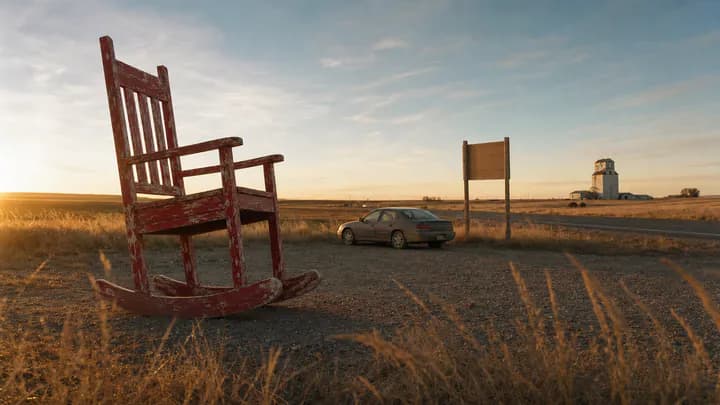
Forty-one feet of laminated oak, painted barn red, faded on the south side to the color of an old brick. The runners curved like the hulls of two overturned boats. The seat was high enough that a stepladder had been bolted to one leg, and there was a plywood platform up there where, according to every postcard her uncle ever mailed, you could sit and see four counties and a grain elevator.
The sign at the turnoff had been repainted so many times the letters stood up from the board like scar tissue.
SECOND LARGEST ROCKING CHAIR IN AMERICA. NO FOOLING.
The wind came across the field, and the chair moved. Not much — a quarter inch, maybe, the whole immense thing shifting on its runners with a groan Margo felt in her molars. She had forgotten it did that. She had been nine the last time she stood here, and she had cried, and Uncle Dell had said, It's just talking, honey.
Brody Fisk from the county tourism board found her three days later, elbow-deep in a box of unsold thimbles.
"Miss Vance." He had a laminated folder and the earnest, scrubbed look of a man who had recently attended a conference. "I'm going to say the thing everybody's been too polite to say."
"Add a foot," said Margo.
He blinked. "Four, actually. Give yourself margin. Tarn Hollow, Indiana, is forty-two feet even. You go forty-six, you're the largest rocking chair in America, and that's a different animal entirely." He flipped the folder open to a bar chart. "Tarn Hollow does sixty thousand visitors a year. Dell did eleven hundred. Eleven hundred, and half of those were school buses that didn't buy anything."
"The structure's sound?"
"Engineer says you'd splice the back posts and extend the crest rail. Two weekends. The board would cover materials." Brody leaned in with real feeling. "Ma'am, people don't drive ninety minutes off the interstate for second. Nobody in the history of this country has ever pulled over for second."
Margo looked out the window. A family had stopped — minivan, Ohio plates — and a small boy was climbing the ladder with his father's hand hovering behind his back.
"I'll think about it," she said.
Forty-Eight Postcards
She found the cigar box that night, in the shed, under a coffee can of drill bits.
Forty-eight postcards, rubber-banded in order. Every one of them showed the same photograph from a slightly different decade: an enormous rocking chair in a field of soybeans, a water tower behind it, GREETINGS FROM TARN HOLLOW in cheerful arced letters. The earliest was postmarked 1971. The newest was postmarked in March, two weeks before her uncle died.
The backs were nearly empty. That was the thing that got her.
1971: Still taller. — V.
1972: Still taller. — V.
1983: Still taller. Sorry about your knee. — V.
1994: Still taller. Repainted. Green was a mistake. — V.
2009: Still taller. Grandbaby number six. — V.
March, this year: Still taller. Call me sometime, you stubborn man. — V.
And on the margin of each one, in her uncle's blunt carpenter's pencil, the draft of his reply, scratched out and rewritten until it was always the same two words.
Still shorter.
Margo went outside with a flashlight and the surveyor's tape from the shed and measured the chair at two in the morning because she could not have slept anyway. Forty-one feet, zero inches, from runner to crest rail. Not forty feet eight. Not forty-one and a half.
Exactly one foot short. For fifty-three years, exactly one foot short.
The story around the county had always been that Dell ran out of money before he ran out of ambition. Margo had repeated that story herself at his funeral, as a kind of joke, and people had laughed the warm sad way they do.
She sat down on the bottom step of the ladder in the dark and felt the whole structure shift half an inch above her, groaning, talking.
The phone number was on the back of the March card, written small, as if the writer expected to be ignored again.
Verna Kessler answered on the fourth ring. Her voice sounded like a screen door in a good breeze.
"Who's this?"
"My name's Margo Vance. Dell was my uncle."
A pause with weather in it. "Was."
"March. It was quick, if that helps."
"It doesn't, particularly, but thank you." Another pause. "I knew. My chair's been quiet since spring. Don't ask me to explain that, I'm eighty-nine and I've earned a little nonsense."
Margo pressed the postcard flat on the counter. "Mrs. Kessler. Why is mine one foot short?"
Verna laughed, and then coughed, and then laughed again. "Because he measured mine."
"I don't understand."
"Nineteen seventy-one. My husband and my brother-in-law and half the Rotary built that thing to get people off the highway, and it worked, and Dell drove out from your part of the world to see it while the paint was still tacky." She took a breath. "We'd known each other in the service, before either of us was anybody. He walked around that chair three times with a tape and didn't say one word. Then he shook my hand and drove nine hundred miles home and built his own."
"One foot short."
"I called him up hollering. I said, Dellwood, you had the lumber, you had the land, you could have taken it from me clean and I'd have shaken your hand for it." Verna's voice went thin and then steadied. "And he said — I've had fifty years to get this right, so I've got it right — he said, Verna, if I beat you, that's the end of it. Nobody writes to the second-largest anything. But somebody's always got to write to the first."
Margo stood in the little gift shop with the thimbles and the dust and the smell of cedar and did not trust herself to speak.
"That man," said Verna, "bought himself a conversation. Forty-eight postcards' worth. Cheapest thing he ever built." A rustle, a chair creaking on her end too. "Now. Somebody from your county called my county about permits last week, so I know exactly what they're asking you to do."
"They want four feet."
"Don't you dare," said Verna Kessler. "I'm eighty-nine. Let me die taller."
Margo called Brody Fisk on Monday and told him no, and he took it well, considering, which is to say he sent one more email with a bar chart in it and then let it go.
She spent September repainting the sign herself. She kept every raised letter of the original and added, underneath, in her uncle's blocky capitals:
AND ON PURPOSE.
Inside, she put out a spiral notebook on the counter with a line drawn down the middle and a question at the top: What are you second-best at? It filled up faster than the postcard rack ever had. Second chair clarinet, 1987, and I was better than the girl who got first. Second-best pie at the county fair. Twice. Runner-up, state wrestling, 132 pounds, still think about it. Second wife. Happiest man alive. People wrote things down and stood there a second longer than they needed to, like they'd set down something heavy.
In October a boy from the minivan generation asked her, upside down from the ladder, who had the biggest one.
"Tarn Hollow, Indiana," Margo said. "Forty-two feet. Take the state road, it's prettier. Tell the lady at the counter that Dell's niece says hello."
The boy went down the ladder two rungs at a time and the wind came across the stubble field and the chair shifted on its runners, groaning, unhurried, saying the only thing it had ever said. Margo stood in the doorway with a rag in her hand and listened, and nine hundred miles east, in a field of soybeans, she was fairly sure something creaked back.
Frequently asked questions
Why does Dell's decision to build one foot short feel like an act of love rather than defeat?
Because a record ends a conversation and a margin continues one. By choosing to stay second, Dell kept a line open across nine hundred miles for forty-eight years, which is longer than most victories last.
What does the guestbook of second-best things reveal about the people who stop?
It shows that almost everyone is carrying a near-miss they've never been allowed to say out loud with any warmth. Given a blank line and no judgment, they write it down almost gratefully.
Is Brody Fisk a villain, or simply speaking a different language?
He's fluent in traffic counts and Margo is learning to speak in postcards. Neither dialect is wrong, but only one of them can explain why a man would spend his life measuring himself against someone he loved.
What does Margo actually inherit by the end of the story?
Not eleven acres and a gift shop, but a posture toward the world — the willingness to be genuinely, publicly, cheerfully second at something and to point the way to whoever's first.