How to Mix Patterns Using Scale, Color and One Solid Anchor
Pattern mixing rests on three rules: vary the scale, share at least one color and keep one solid anchor piece. Here are worked outfits from two-pattern basics up to three.
Drafted with AI. This version has not been reviewed by an editor, so it carries no ads — how we work.
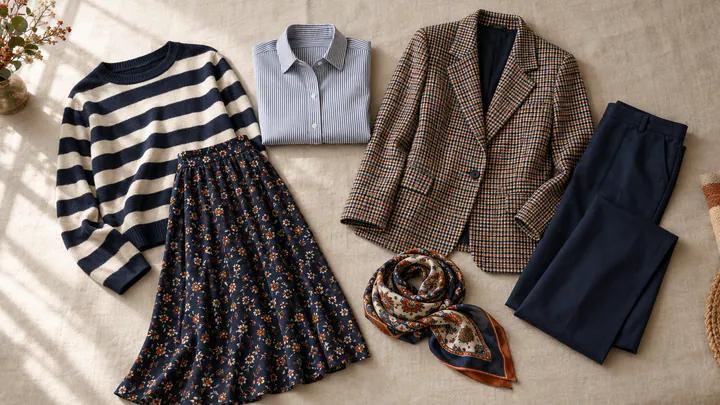
Two patterns look deliberate rather than accidental when three things are true: one pattern is clearly bigger than the other, both share at least one color, and a large solid piece sits somewhere in the outfit to give the eye a rest. If you own striped shirts, a checked jacket or a floral skirt but only ever wear them with plain jeans and white tees, those three rules are what let you put them together. Below are the rules, then worked outfits that start with two patterns and build to three.
The three rules: vary scale, share a color, anchor with a solid
Scale: pair a large pattern with a small one
Scale means the size of a pattern's repeat: how far apart the stripes are, how big the checks or flowers are. When two patterns are close in scale, they compete for attention and the eye can't settle on either. When one is clearly larger, it reads as the main pattern and the smaller one reads almost as texture.
A useful rough test: the larger repeat should be at least two or three times the size of the smaller one. A shirt with stripes about 1/8 inch apart pairs easily with a jacket check about an inch or more across. A Breton top with stripes roughly an inch wide pairs with a floral whose flowers are smaller than a fingernail. Patterns in between, around half an inch, are the trickiest to combine because they sit close to almost everything.
Color: pull one shared color through both
The patterns don't need to match, but they need a link. The simplest link is one color that appears in both: the navy in a stripe shows up again as the stems in a floral, or the rust in a check repeats as a thread in a tie. The shared color does the most work when it is dominant in one pattern and an accent in the other.
Backgrounds count. Two patterns on the same white or cream ground already share a color, but check that the whites agree: a bright optical white next to an ivory can make the ivory look dingy.
Anchor: keep one large solid piece
An anchor is a solid garment big enough to break up the patterns: trousers, a skirt, a coat, a plain dress under a patterned jacket. It stops the outfit from reading as one busy surface. Ideally the anchor is in the shared color, which ties everything together. Navy, charcoal, camel, olive, denim and black all work because they sit comfortably beside most prints.
Before you leave the house, stand back from a mirror, about 6 feet away, and squint. If you can still tell the two patterns apart and one clearly leads, the outfit works. If they blur into a single gray haze or seem to vibrate, change one piece.
The easiest pairings: stripes with florals, checks with dots
Some pattern families get along because their shapes are different. Stripes and checks are straight-edged and geometric; florals and dots are rounded. Pairing a geometric pattern with an organic one makes it easy to tell them apart, even at similar sizes, so these are the best first combinations.
Worked example: Breton stripe top with a small floral midi skirt
- Top: a navy-and-white Breton top with broad stripes, roughly an inch each.
- Skirt: a midi skirt with a small floral in navy, white and a touch of red or green on a cream ground.
- Shared color: navy, dominant in the top and an accent in the skirt.
- Anchor: here the skirt is patterned, so the anchor shifts to outerwear and shoes: a solid navy cardigan or a camel trench, plus plain leather flats or white sneakers.
This works because the stripe is large and graphic while the floral is small and busy, so they don't fight. If you already lean on the Breton top for nautical outfits built around navy and white, the floral skirt is a low-risk way to take it somewhere new.
Checks with dots
A gingham shirt with checks about a quarter inch across sits well under a sweater or jacket, with a polka-dot scarf whose dots are larger and more widely spaced. Or reverse it: a bold buffalo check overshirt over a fine pin-dot blouse. Keep the colors linked, for example red gingham with a navy scarf carrying small red dots, and wear solid dark jeans as the anchor.
Same pattern, different scale: stripes with stripes
Two striped pieces can look sharp, but only if the stripes are clearly different widths. A fine pinstripe shirt under a wide-striped knit vest, or a thin-striped button-down tucked into a skirt with bold awning stripes, reads as intentional because one stripe obviously dominates.
The failure case is two fine stripes of similar spacing. When closely spaced parallel lines overlap or sit side by side, they can produce a shimmering, rippling effect known as moiré. In person it looks like a visual flicker; on camera and video calls, fine stripes and tight checks are especially prone to strobing. If both stripes are under about a quarter inch apart, keep them away from each other.
Direction helps too. A vertical stripe on a shirt with a horizontal stripe on a sweater, or a diagonal stripe on a tie against a vertical shirt stripe, gives each pattern its own line and reduces the risk of flicker.
Tailored looks: shirt, tie and jacket patterns together
Tailoring has the longest tradition of pattern mixing, and the same three rules apply. The jacket is usually the largest area, the shirt the smallest-scale pattern, and the trousers the anchor.
Worked example: pinstripe shirt, check blazer, navy trousers
- Shirt: a white shirt with a fine blue pinstripe, lines about 1/8 inch apart.
- Blazer: a medium check, such as a windowpane or glen check, with lines an inch or more apart, in gray with a blue overcheck.
- Trousers: solid navy.
- Shared color: blue, in the shirt stripe and the blazer's overcheck, deepened by the navy trousers.
The pinstripe is fine enough to read almost as a texture from a few feet away, so it doesn't compete with the check. The navy trousers are the anchor, and because they echo the blue in both patterns, the whole outfit holds together. Solid dark shoes and a plain belt keep the lower half calm; matching the belt to your shoes and trousers matters more when the top half is busy.
Adding the tie
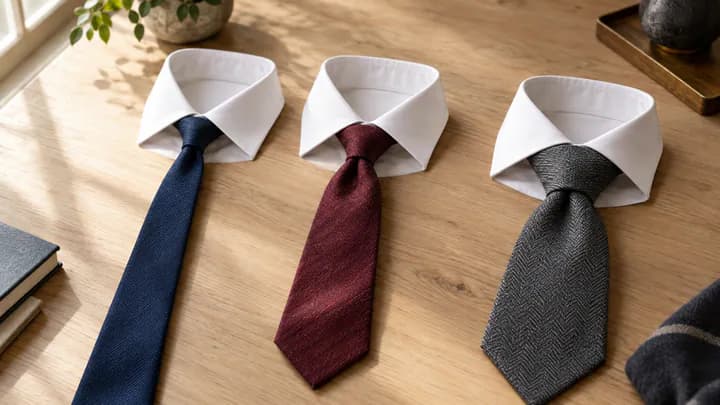
A tie is a small area, so it can carry a bolder or larger pattern than you might expect. With the outfit above, a solid knit tie keeps it to two patterns. To make it three, pick a tie whose pattern differs in both shape and scale from the shirt and jacket: a widely spaced diagonal stripe, a medium paisley or a spaced-out dot in navy and burgundy. Avoid a tie with a tight check or fine stripe close in size to the shirt's pinstripe.
Casual outfits: scarves, bags and shoes as the second pattern
If patterned garments feel like too big a step, start with an accessory. A patterned scarf, bag or pair of shoes covers a small area, is easy to remove if it isn't working, and lets you practice the color rule without committing a whole outfit.
- Scarf: a silk scarf with a medium floral or paisley tied at the neck of a fine-stripe shirt. Pick one that repeats the shirt's stripe color.
- Bag: a tote in a bold check or woven stripe with a small-print blouse. The bag sits away from the face, so it can be larger and louder.
- Shoes: leopard or snake-print flats behave almost like a neutral and sit comfortably beside stripes, checks or florals, as long as the outfit includes some brown, tan or black to link them.
Once a patterned accessory feels natural, you can treat it as the bold piece and build around it, the same way a statement accessory becomes the focus of an outfit. Then swap the accessory for a patterned garment of similar scale.
Going to three patterns without looking busy
Three patterns work when each one has a distinct job. Use this checklist:
- Three scales: one small, one medium, one large. If two are similar in size, change one.
- One color through all three: the same navy, rust or green should appear somewhere in each pattern.
- The third pattern on the smallest area: a tie, pocket square, scarf, socks or shoes, not a second large garment.
- A solid anchor still in place: trousers, a skirt or a coat in a solid color, ideally the shared one.
Worked example: building the Breton outfit to three
Start with the navy Breton top and small navy floral midi skirt from earlier. Add a scarf with medium navy dots on cream, knotted at the neck or tied to a bag handle. The dots sit in size between the broad stripe and the small floral, and navy runs through all three. Keep the anchor solid: a navy cardigan or plain camel coat, and solid shoes. If it starts to feel busy, the scarf comes off first.
Worked example: tailored three-pattern look
Take the pinstripe shirt, check blazer and navy trousers, and add a pocket square with a medium paisley in blue and burgundy. Pinstripe is the small scale, paisley the medium, check the large. A solid knit tie in navy keeps the area around the face from tipping into four patterns.
Combinations to avoid and why they clash
| Combination | Why it clashes | Fix |
|---|---|---|
| Two fine stripes of similar spacing | Lines interfere and create a moiré flicker | Make one stripe at least two to three times wider, or swap one for a solid |
| Two large, bold prints (big floral with big plaid) | Both demand attention; neither leads | Shrink one to a small-scale version |
| Same pattern, same scale (gingham with matching gingham) | Looks like a mismatched set rather than a choice | Vary the check size or change one pattern type |
| Patterns with no color in common | Nothing links them, so they look thrown together | Pick pieces that share at least one color, or add a solid in a bridging color |
| Warm-toned print with a cool-toned print (orange-and-brown floral with icy blue-and-gray check) | The colors pull in different directions | Keep both prints in the same color family or link them with a neutral |
| Patterns head to toe with no solid | No resting point for the eye | Replace the trousers, skirt or coat with a solid |
Many-colored prints are the other trap. Two prints that each carry five or six colors are hard to link, because the shared color gets lost. If one pattern is very colorful, keep the other to two colors, one of which appears in the first. When in doubt, pull the pattern you like least and replace it with a solid in the shared color: the outfit almost always settles.