Home Decor Trends 2025: Is Biophilic Design Still In?
Biophilic design is still the strongest idea in 2025 decor, but it has moved past houseplants into light, materials, and views. Here's what's worth spending on, what dates fastest, and how to pull it off in a rental.
Rewritten with AI and republished automatically. Our editors set the standards and fix reported errors — how we work.
TL;DR: Yes, biophilic design is still in for 2025 — but it has grown up. The focus has moved from houseplants to daylight, real materials, and views. Alongside it: saturated color, tactile surfaces, longer-lasting furniture, and rooms that change jobs during the day. Spend on light and materials; keep the trendy shapes cheap.
What is biophilic design, and is it actually still in for 2025?
Biophilic design is an approach to interiors and architecture that deliberately builds in contact with nature — daylight, natural materials, organic forms, views, plants, and airflow — because people generally feel calmer and more focused in spaces that reference the natural world. It is still very much in for 2025, and it is one of the few current trends we'd call durable rather than fashionable.
The reason is simple: most of what biophilic design asks for isn't decoration. Bigger windows, unpainted wood, stone, clay, wool, a sightline to something green — those don't become dated, because they were never novelties. The term traces back to the "biophilia" idea popularized by biologist E.O. Wilson and was turned into practical design principles by researchers including Stephen Kellert. Research in healthcare and workplace settings has long suggested that daylight and views of nature are associated with better mood and recovery, which is why hospitals and offices adopted these ideas before living rooms did.
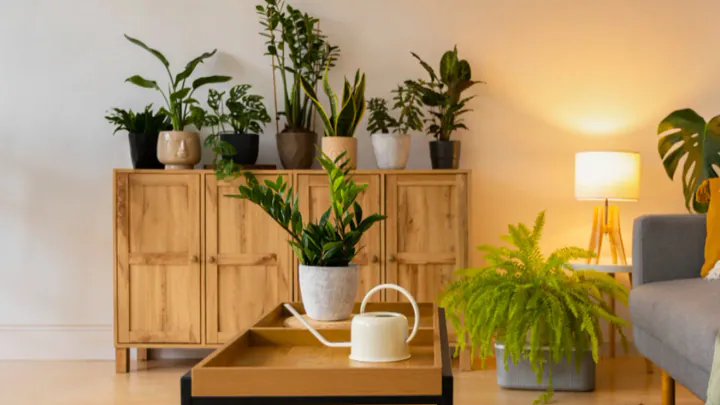
What has changed in 2025 is the execution. The 2021-era version — a fiddle-leaf fig in a woven basket — is now the visual shorthand for a room that skipped the harder work.
How do I add biophilic design without killing every plant I buy?
Start with light and materials, not greenery. Plants are the fourth thing on the list, not the first, and they are the only element that can die and make the room look worse than before you started.
In priority order:
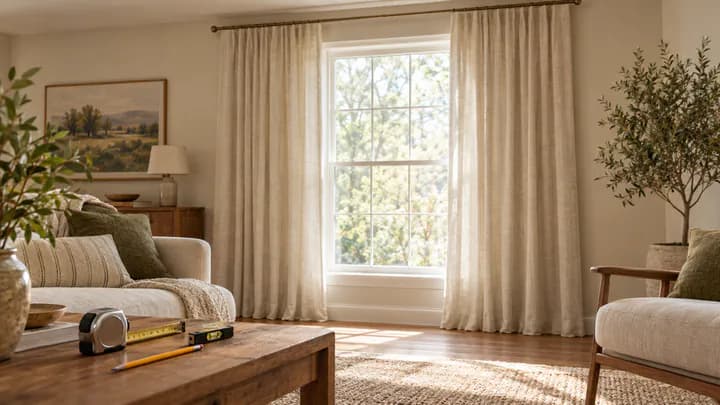
- Clean and uncover the windows. Move curtain rods four to six inches above the frame and wide enough that open drapes clear the glass entirely. This alone can transform a dim room, and it costs nothing but an afternoon.
- Put a mirror opposite a window, not on a blank wall. A mirror reflecting a wall just doubles the wall.
- Swap three plastic or laminate objects for real materials — a wooden tray, a stoneware lamp base, a linen cushion cover. Real materials age with variation; synthetics only wear.
- Then buy plants, and match them honestly to the light you actually have. A north-facing room gets pothos, ZZ plant, snake plant, or cast-iron plant. A south-facing window gets almost anything.
The honest caveat: if your apartment has one small window facing a wall, no amount of design will make it a biophilic space. In that situation, put your money into layered artificial lighting — warm 2700K bulbs, three separate light sources at different heights — and into texture. Faking daylight with a single bright ceiling fixture makes a dark room look worse, not better. A daily dose of real outdoor light does more for how you feel than any interior scheme.
Which 2025 color trends are worth committing to?
Saturated, grounded colors are the defining shift of 2025 — deep forest and olive greens, terracotta and burnt orange, ochre, oxblood, and warm charcoal. Beige hasn't disappeared, but it has moved from being the whole scheme to being the backdrop.
The decision rule we use: commit paint to color, commit furniture to neutral, commit accessories to whatever you like. Paint is cheap to undo; a green velvet sofa is not. If you love a color enough to want it permanently, put it on walls, cabinetry, or a painted bookshelf — all of which can be repainted in a weekend.
The costly mistake we see constantly: painting a single dark accent wall in a room lit by one cool-white ceiling fixture. It reads as a flat, heavy rectangle rather than as depth. If you're going dark, carry the color onto the trim and ceiling and add two warm lamps at eye level. Half-committing to a dark color is worse than not doing it.
Test properly, too. Paint a large sample — at least two feet square — onto poster board rather than the wall, and move it around the room across a full day. Undertones that look sophisticated at 10 a.m. by a window can turn green or purple under evening lamplight.
How do I add texture without a renovation budget?
Texture is the cheapest way to make a plain room look considered, and 2025 leans hard on it: fluted and reeded wood, limewash and clay-plaster walls, boucle, nubby wool, raw linen, unglazed ceramics, and hand-thrown pottery.
A useful constraint is the three-material rule: in any one room, pick three natural materials and repeat each at least twice. Oak, wool, and stoneware. Or rattan, linen, and blackened metal. Repetition is what separates "layered" from "cluttered," and it's why a room full of expensive individual pieces can still feel incoherent.
Two practical warnings from experience. First, limewash is beautiful but it is not a normal paint job — it needs a mineral primer on drywall, it applies in cross-hatched strokes, and it looks alarming until it fully cures. Test a closet wall first. Second, much of the boucle sold cheaply is synthetic and pills badly at contact points within a year. On a chair you'll sit in daily, wool or a tight performance weave will outlast it.
Which 2025 trends are worth the money, and which should stay cheap?
Spend where the item is structural, permanent, or touched daily. Keep it cheap where the appeal is a recognizable shape.
| Trend | Rough effort | Renter-friendly? | How long it lasts | Verdict |
|---|---|---|---|---|
| Maximizing daylight (curtains, mirrors, layout) | An afternoon | Yes | Permanent | Do this first |
| Warm layered lighting (lamps, 2700K bulbs) | One weekend | Yes | Years | Best value change |
| Saturated wall color | One weekend | With permission | 5-10 years | High impact, low risk |
| Limewash / clay plaster walls | 2-3 days plus curing | Rarely | 10+ years | Worth it if you own |
| Solid-wood or reclaimed furniture | Purchase | Yes | Decades | Spend here |
| Boucle and statement-shape accessories | Purchase | Yes | 2-4 years | Keep it inexpensive |
| Modular and folding furniture | Purchase plus setup | Yes | 5-10 years | Buy for how you live |
How do I make one room work as an office, a gym, and a dining room?
Define zones with floor, light, and storage rather than walls — a rug marks a boundary more cleanly than a divider, and a dedicated lamp tells your brain which mode the room is in. The goal is that switching modes takes under two minutes, because anything slower simply won't happen on a busy Wednesday.
What actually works in practice:
- A closed container for the work stuff. A lidded basket or a cabinet that swallows the laptop, cables, and notebook in one motion. Visible work equipment keeps a room in office mode after hours.
- Wall-mounted or folding surfaces — a drop-leaf desk, a wall-hung shelf at 29 inches — that return the floor when you're done.
- Casters on anything heavy you need to move weekly, including a console or a side cabinet.
- Separate circuits of light: bright task lighting for work, low warm lamps for evening. Same room, different building.
Where this fails: modular sectionals that are advertised as reconfigurable but weigh too much to reconfigure alone. If you live by yourself, test whether you can actually move the piece before you buy it. A flexible room you can't physically rearrange isn't flexible.
What does "emotional design" mean in practice, beyond a gallery wall?
Emotional design means the room contains objects with a story — inherited, handmade, collected on a trip, made by someone you can name — rather than a showroom set bought in one transaction. It is the most quietly radical trend of 2025, because it argues against buying anything at all.
The practical version is a rule about pace: bring in one meaningful object at a time and live with it for a month before adding the next. Rooms assembled over two years look like someone lives there. Rooms assembled in one weekend look like a listing photo, and are the ones people replace wholesale in three years.
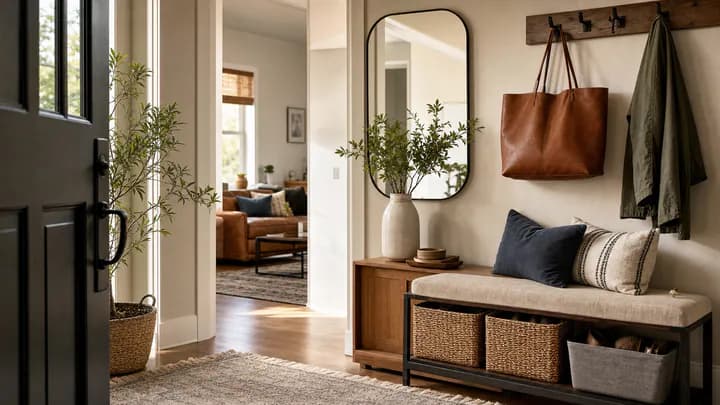
This applies at the front door as much as anywhere. The first few feet of a home say more about who lives there than the living room does — we break down how to handle that small, high-traffic space in our guide to entryway design and the first three feet.
How do I turn a bedroom into an actual sanctuary?
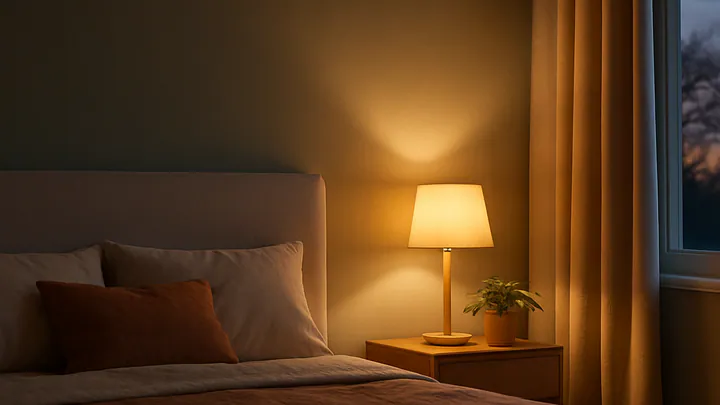
Treat the bedroom as the one room where the 2025 color trend does not apply. Neutrals, low contrast, and dim warm light still win here, because the room's job is to help you stop being alert.
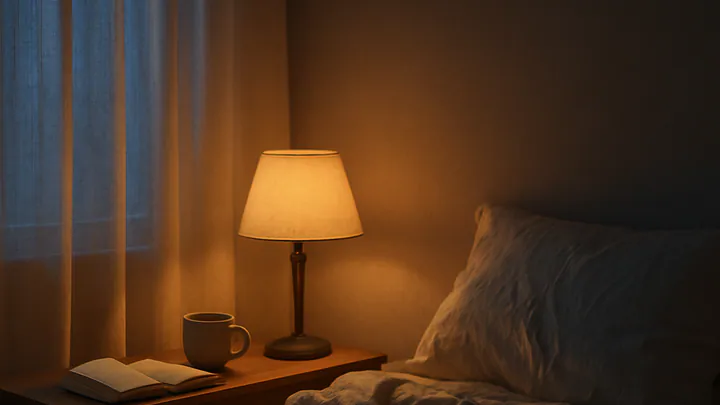
The highest-value changes, in order: genuine blackout coverage at the window edges (light leaking around the sides defeats an expensive blind), bulbs under 2700K on the bedside lamps, no overhead light after dark, and natural fibers against the skin — linen, cotton percale, wool. Scent and sound are finishing touches, not foundations.
Biophilic principles suit bedrooms well because they're subtractive: fewer hard surfaces, more soft and natural ones, and a view of something living if you have it. For a full room-by-room plan, see our bedroom refresh guide to calm, cozy upgrades, and if the real problem is accumulated exhaustion rather than the room itself, recovering from sleep debt is the more useful starting point. Design can support rest; it can't treat a sleep disorder, and persistent sleep trouble is worth raising with a qualified professional.
What will date fastest, honestly?
Anything defined by a silhouette rather than a material. Arch-topped everything, checkerboard tile and rugs, wavy mirrors, and synthetic boucle are all instantly placeable to this moment — which is fine on a $40 accessory and expensive on a sofa or a built-in.
Two more honest limits. Sustainability claims are uneven: "eco" labeling means little on its own, while third-party marks like FSC for wood or recognized low-VOC certifications for paint mean something specific. And the single most sustainable choice is almost always keeping or buying secondhand what already exists — a repaired solid-wood dresser beats a new one made from responsibly sourced particleboard.
Finally, none of these trends are obligations. If beige makes you happy, beige is correct for your home. The real thread running through 2025 isn't a palette — it's the idea that a room should be judged by how it functions and how it feels at 7 p.m. on a Tuesday, not by how it photographs.
Key takeaways
- Biophilic design is still in, but the 2025 version is about daylight, materials, and views — plants are the finishing touch, not the strategy.
- Spend on light, materials, and anything you touch daily; keep trendy shapes and finishes cheap and replaceable.
- Commit paint to color, furniture to neutral. A dark room needs the trim, ceiling, and warm lamps too — half-committing looks worse than not doing it.
- Use the three-material rule — pick three natural materials per room and repeat each at least twice — to get layered instead of cluttered.
- Bedrooms are the exception: keep them neutral, low-contrast, and dim, with blackout coverage that seals at the edges.
- Add meaningful objects one at a time. Rooms assembled slowly look lived in; rooms assembled in a weekend get replaced in three years.
Frequently asked questions
Is biophilic design still in style in 2025?
Yes — biophilic design is still central to 2025 interiors, but it has shifted away from plant-heavy styling toward daylight, natural materials, views, and airflow. Those elements are architectural rather than decorative, which is exactly why they don't go out of fashion the way a styling trend does.
What is biophilic design in simple terms?
Biophilic design is an approach to architecture and interiors that deliberately builds in contact with nature — daylight, natural materials, plants, water, views, and organic shapes — because people tend to feel calmer and more focused in spaces that reference the natural world. The term grows out of the "biophilia" hypothesis popularized by biologist E.O. Wilson and later developed into design principles by Stephen Kellert.
Can you do biophilic design in a rental?
Yes, and it's mostly free. Clean the windows, remove heavy drapery from the top third of the glass, move seating toward the light, swap plastic accessories for wood, stone, clay, wool, and linen, and place a mirror opposite a window rather than on a blank wall. None of that requires a landlord's permission.
What's the cheapest change with the biggest visual impact?
Lighting. Replacing overhead bulbs with warm 2700K bulbs and adding two or three lamps at different heights changes how every color and texture in the room reads, usually for less than the price of a single accent chair.
Are dark, moody paint colors a mistake in a small room?
Not necessarily — dark colors can make a small room feel enveloping rather than cramped, but only if you carry the color onto the trim and ceiling and layer in warm lamp light. The genuine mistake is painting one dark accent wall in a room with cool overhead lighting, which reads as a flat, heavy rectangle.
Which 2025 trend will date the fastest?
Highly recognizable silhouettes and finishes — chunky arch mirrors, checkerboard everything, and mass-produced boucle in synthetic fabric. They're fine as inexpensive accessories; they're a poor choice for a sofa or a built-in you'll keep for a decade.